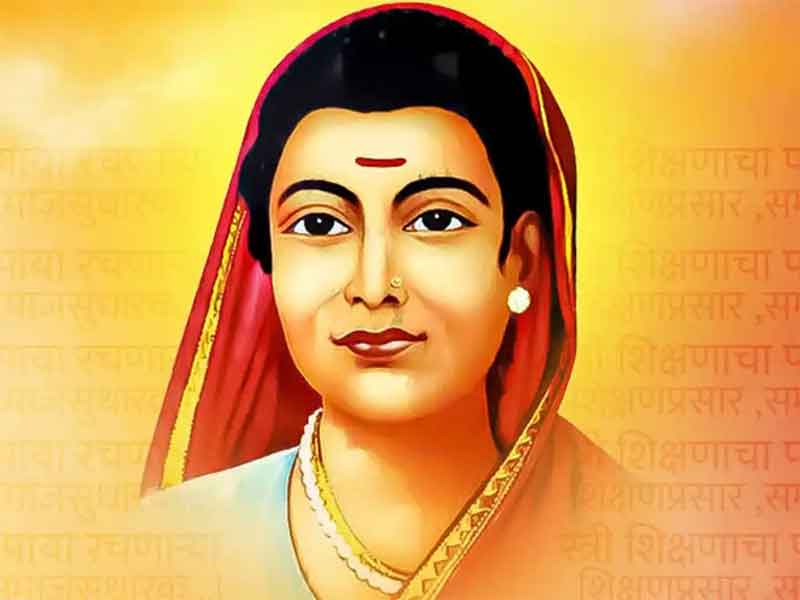


Before millions of girls in India had the right to step into a classroom, Savitribai Phule stepped into history by challenging centuries of discrimination. Born on 3 January 1831 into the Mali community, she became India's first professionally trained female teacher, an educator, poet, and one of the country's most influential social reformers.
Married to Jyotirao Phule at a young age, Savitribai was initially denied an education herself. Refusing to accept this injustice, she learned to read and write under her husband's guidance and later received formal teacher training. What began as her personal journey toward education soon became a movement that transformed the lives of countless women and marginalized communities.
In 1848, Savitribai and Jyotirao Phule established India's first school for girls at Bhide Wada in Pune. At a time when educating girls was considered unacceptable, they introduced a progressive curriculum that included mathematics, science, and social studies. Their work challenged deep-rooted caste and gender discrimination and laid the foundation for modern education in India.
Despite facing insults, threats, and relentless social opposition, Savitribai refused to back down. By 1851, the couple was successfully running three girls' schools with around 150 students, and eventually established 18 schools dedicated to expanding educational opportunities for girls and marginalized communities.
Her commitment extended far beyond classrooms. She helped establish the Mahila Seva Mandal to promote women's rights, founded the Balhatya Pratibandhak Griha to protect widows and prevent female infanticide, and co-founded the Satyashodhak Samaj, a movement dedicated to equality and social justice.
Savitribai was also an accomplished writer whose works, including Kavya Phule (1854) and Bavan Kashi Subhodh Ratnakar (1892), reflected her vision of an equal and educated society.
In 1897, while caring for victims during the bubonic plague epidemic, Savitribai Phule contracted the disease and passed away. She died serving others, leaving behind a legacy that continues to inspire generations.
Today, Savitribai Phule is remembered not only as India's first female teacher but as a fearless pioneer who transformed education into a tool of social justice and became one of the strongest voices for equality in Indian history.





.jpg)
.jpg)

.jpg)
.jpg)
.jpg)
.jpg)
.jpg)