


The BRICS Summit being hosted by India has achieved a significant diplomatic breakthrough, with member countries reaching consensus on a joint declaration. The document, titled the ‘BRICS New Delhi Declaration’, is set to reflect the group’s collective position on global conflicts, military escalation and the need for peaceful resolution of disputes.
The agreement comes at a time when tensions in West Asia remain a major concern for the international community. The consensus among BRICS members is particularly significant because several countries within the grouping have differing strategic and political positions on ongoing conflicts.
Consensus on the joint declaration
After several rounds of discussions, BRICS members have agreed on the language of the joint declaration. The document is expected to condemn aggression in all forms without directly naming any particular country.
The declaration will also underline the importance of dialogue and diplomacy in resolving conflicts. Instead of allowing military confrontation to escalate further, BRICS members are expected to emphasize negotiations, diplomatic engagement and peaceful mechanisms for addressing disputes.
A diplomatic achievement for India
The agreement is being viewed as an important diplomatic achievement for India, which is hosting the summit. Bringing all participating countries together on a common position was not an easy task, particularly because of differences over the wording related to the conflict in West Asia.
BRICS sherpas had been engaged in intensive negotiations ahead of the summit to finalize language acceptable to all members. The discussions focused on finding a balanced formulation that could reflect the concerns of different countries without creating divisions within the grouping.
Differences over the West Asia conflict
The conflict in West Asia had emerged as one of the biggest obstacles to reaching an agreement. Differences between Iran and the UAE over the war and the wider regional situation had affected discussions within BRICS.
A similar challenge had emerged during the BRICS foreign ministers’ meeting held earlier in New Delhi. At that time, the member countries were unable to agree on common language regarding the conflict, and a joint statement could not be issued following the meeting.
Consensus achieved under India’s presidency
The latest agreement demonstrates India’s efforts to bridge differences among BRICS members and build consensus around sensitive international issues. The Indian presidency has focused on maintaining a balanced approach while ensuring that the concerns of different member countries are reflected in the final document.
The agreement also highlights the importance of BRICS as a forum where countries with different geopolitical interests can continue dialogue and work toward common positions on major global challenges.
Modi-Xi bilateral meeting
Prime Minister Narendra Modi is also scheduled to hold a bilateral meeting with Chinese President Xi Jinping on the sidelines of the BRICS Summit. Xi Jinping arrived in New Delhi on Saturday to participate in the summit being held at Bharat Mandapam.
His visit has attracted considerable attention as it comes after several years and marks an important engagement between the leadership of India and China. The two leaders are expected to discuss bilateral relations, regional developments and issues of mutual interest.
Modi’s meetings with Putin and Pezeshkian
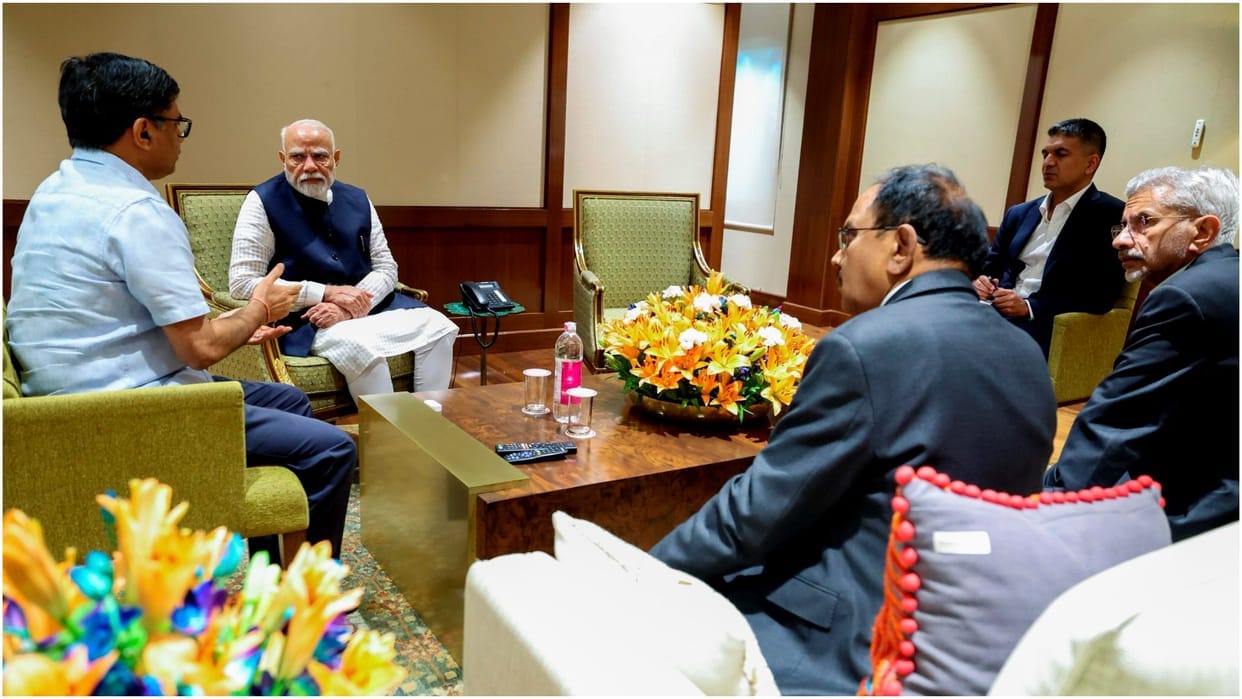
Before the summit, Prime Minister Modi held bilateral discussions with Russian President Vladimir Putin and Iranian President Masoud Pezeshkian.
The meeting with President Pezeshkian was particularly significant against the backdrop of continuing tensions in West Asia. The two leaders discussed India-Iran relations as well as the evolving situation in the region.
Prime Minister Modi’s engagement with President Putin also formed part of India’s broader diplomatic outreach during the BRICS Summit, as New Delhi seeks to maintain dialogue with key partners amid a rapidly changing international environment.
BRICS position on global conflicts
The New Delhi Declaration is expected to place emphasis on the need to prevent further escalation of conflicts. By avoiding direct references to individual countries while condemning aggression, BRICS members have sought to maintain a formulation that can accommodate different national positions.
The focus on dialogue and diplomacy is also consistent with India’s long-standing emphasis on peaceful resolution of international disputes. The approach allows BRICS to present a collective message while avoiding language that could deepen divisions within the grouping.
Significance for BRICS
The consensus on the declaration is important not only for India’s presidency but also for BRICS as a multilateral grouping. With countries representing different regions, political systems and strategic interests, reaching agreement on sensitive geopolitical issues can be challenging.
The New Delhi Summit therefore provides an opportunity for BRICS members to demonstrate that despite differences, they can continue working together on issues of common concern. The joint declaration could also reinforce the grouping’s broader role in discussions on global peace, diplomacy and international cooperation.






.jpg)
.jpg)


.jpeg)


.jpeg)


.jpeg)


.jpeg)


.jpeg)


.jpeg)


.jpeg)


.jpeg)


.jpeg)








.jpeg)
.jpeg)
.jpeg)

.jpeg)
.jpeg)
.jpeg)

.jpeg)

.jpeg)

.jpeg)



.jpeg)
.jpeg)




-1783504412913_v.webp)
.webp)

.jpeg)