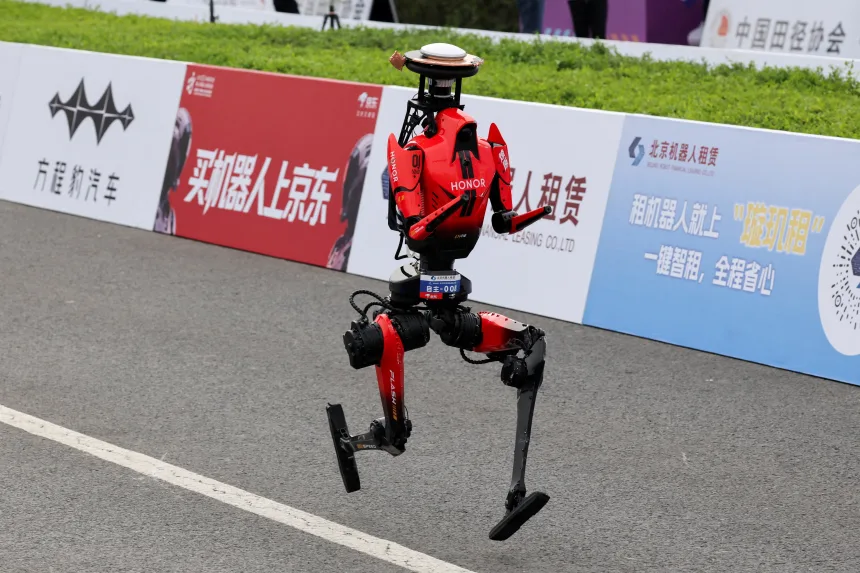



A humanoid robot developed in China has made history by completing a half-marathon faster than any human ever recorded, marking a major milestone in robotics and artificial intelligence.
The android, named Lightning and created by Chinese smartphone maker Honor, finished the 21-kilometer race in Beijing in just 50 minutes and 26 seconds. This time surpasses the current human world record of 57 minutes and 20 seconds, held by Ugandan runner Jacob Kiplimo, by more than six minutes.
Standing 169 centimeters tall, the bright-red humanoid maintained a steady pace throughout the race, using its short forearms for balance. Observers noted that the robot showed no visible signs of fatigue or slowdown as it crossed the finish line ahead of all competitors.
The achievement highlights rapid advancements in China’s robotics sector, which has been expanding significantly over the past decade. Since 2015, the Chinese government has prioritized robotics as a key industry, aiming to transform the country from a manufacturing hub into a global technology leader. A 2023 policy framework further identified humanoid robotics as a critical area of innovation, with goals for large-scale production and improved supply chains by 2025.
The success of Lightning also reflects a growing trend of robot participation in competitive events across China. In recent years, humanoid machines have taken part in various sporting competitions, including soccer, boxing, and martial arts, showcasing their evolving capabilities.
This year’s humanoid half-marathon saw participation from more than 100 teams, a significant increase compared to its debut event. While earlier editions featured limited success, the latest race demonstrated how far the technology has progressed.
In the human category, runners Zhao Haijie and Wang Qiaoxia claimed victories in the men's and women’s races, respectively, each finishing in over an hour.
Event organizers credited Lightning's advanced navigation system and powerful acceleration as key factors behind its record-breaking performance. The robot also significantly outperformed the previous champion machine, finishing nearly two hours faster.
The result signals a new era in the intersection of sports and technology, raising questions about the future role of robotics in competitive environments and the boundaries between human and machine performance.









.jpg)
.jpg)






.jpeg)











.jpeg)












.jpeg)









.jpeg)


.jpeg)
























.jpeg)

.jpeg)






.jpeg)
.jpeg)






























.jpeg)



























.jpeg)






.jpeg)






.jpeg)




.jpeg)




















.jpeg)


.jpeg)


.jpeg)