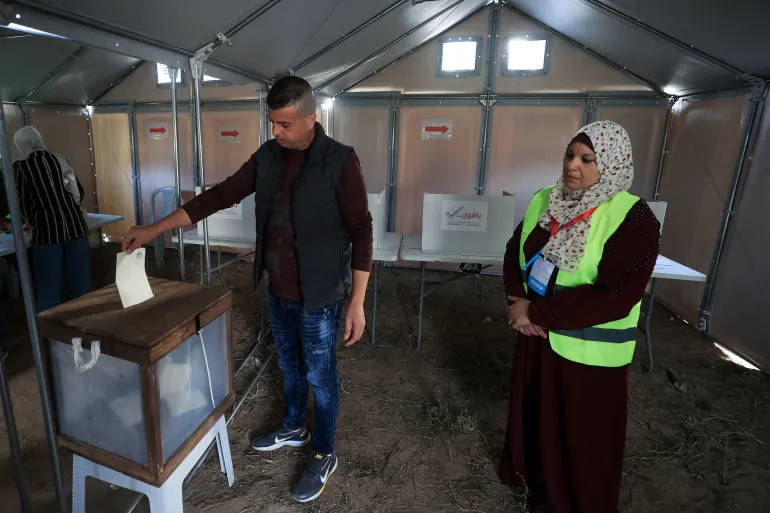


Voting has begun in parts of Gaza and the occupied West Bank in a significant municipal election, marking the first local vote in Gaza in nearly two decades. The polling process is being closely watched as a test of political engagement during an ongoing period of conflict and instability.
In central Gaza, polling stations opened early in the Deir el-Balah area, where around 70,000 eligible voters are taking part. Officials have described the vote as a “pilot” initiative, given the extraordinary conditions in the region and the challenges of organising elections after years of conflict.
At the same time, nearly 1.5 million registered voters in the occupied West Bank are casting their ballots to elect representatives for local councils responsible for essential services such as water, electricity and road management. The elections are seen as an effort by Palestinian authorities to reinforce governance and restore some level of public trust.
Organising the vote in Gaza has required significant adjustments. Electoral authorities were unable to carry out standard voter registration procedures or transport materials like ballot boxes and papers into the enclave. Despite these obstacles, officials say the process aims to symbolically link Gaza and the West Bank within a single political framework.
The elections are taking place against the backdrop of longstanding political divisions. The Fatah movement, led by Palestinian President Mahmoud Abbas, dominates most candidate lists, along with independent figures. Hamas, which has controlled Gaza since 2007, is not officially participating in the vote.
Local elections in Palestinian territories have historically seen moderate voter turnout, and officials are hoping participation remains steady despite current hardships. Analysts say the elections could provide insight into public sentiment, particularly amid frustration over governance, economic conditions and the absence of national elections since 2006.
Recent electoral reforms have introduced changes aimed at increasing participation and representation, including allowing individuals to run independently of party lists and expanding quotas for female candidates. New requirements also mandate that candidates align with the broader political framework of the Palestine Liberation Organization.
The broader political environment remains complex. Many major cities in the West Bank are not holding elections due to a lack of candidates, while some areas remain under direct Israeli control. Meanwhile, Gaza continues to face extensive destruction and uncertainty over its future governance structure.
Despite these challenges, the elections are being viewed as a rare opportunity for Palestinians to exercise democratic rights during a period of prolonged crisis, even if the immediate impact remains limited.



.jpg)
.jpg)