


India marked a major milestone in its space journey with the successful launch of *Vikram-1*, the country's first privately developed orbital launch vehicle, from the Satish Dhawan Space Centre in Sriharikota. The mission represents a new era for India's commercial space industry and highlights the growing role of private companies in the nation's space ambitions.
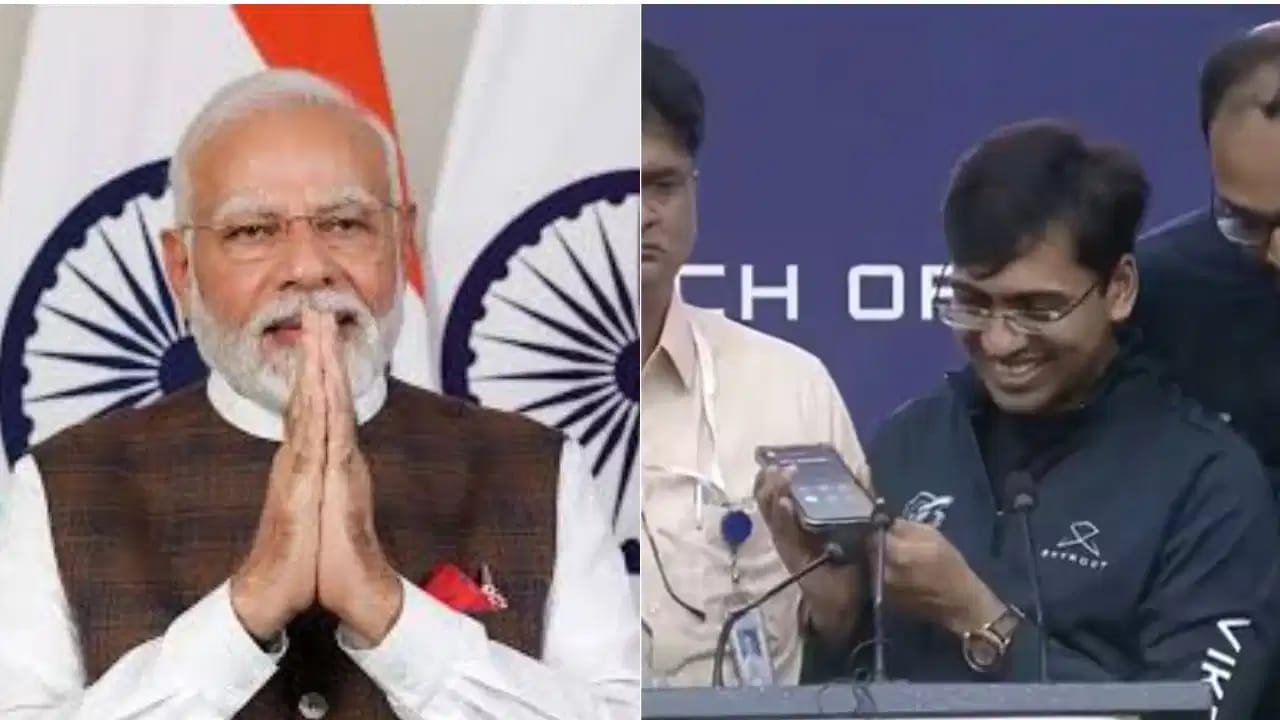
Following the successful launch, Prime Minister Narendra Modi personally congratulated the Skyroot Aerospace team and described the achievement as a proud moment for the country. He said the mission was not merely a rocket launch but the beginning of a new chapter in India's space ecosystem. Calling it *"Mission Agaman,"* the Prime Minister said the journey had only just begun and India must continue moving forward with confidence.
During his interaction with the founders and engineers of Skyroot Aerospace, the Prime Minister praised the young team, noting that most members appeared to be in their twenties and early thirties. He said their success reflects the tremendous potential of India's youth and proves that when given opportunities, young innovators can achieve world-class results.
PM Modi recalled that when the government decided to open the space sector to private participation, many doubts and concerns were raised. However, he remained confident in the capabilities of Indian startups and engineers. According to him, Vikram-1's successful mission has validated that decision and strengthened the belief that India's youth can deliver cutting-edge technological achievements.
The Prime Minister also sent a special postcard carrying the words *"Vande Mataram"* to the Skyroot team. The mission coincided with the 150th anniversary of the national song. After the launch, Skyroot CEO Pawan Kumar Chandana informed the Prime Minister that the postcard had successfully reached orbit along with the mission, symbolically taking "Vande Mataram" into space.
Skyroot Aerospace described the achievement as historic not only for the company but also for India's growing private space ecosystem. The company stated that Vikram-1 was completely designed, developed and manufactured in India, showcasing the country's technological capabilities and self-reliance.
The 23-meter-tall launch vehicle lifted off at 12:05 PM and successfully placed its payload into a 450-kilometre Low Earth Orbit. The mission achieved its primary objective of validating India's first privately built orbital launch vehicle.
Vikram-1 is a three-stage solid-fuel rocket built using advanced carbon-composite structures. It features a restartable Orbit Adjustment Module (OAM), enabling the deployment of multiple satellites into different orbital positions. The vehicle is capable of carrying up to 350 kg to Low Earth Orbit and approximately 260 kg to Sun-Synchronous Orbit.
The success of Vikram-1 is expected to strengthen India's position in the rapidly expanding global small satellite launch market. Industry experts believe the mission will encourage greater private investment, innovation and international collaboration, further establishing India as a competitive player in the commercial space sector.




.jpg)
.jpg)