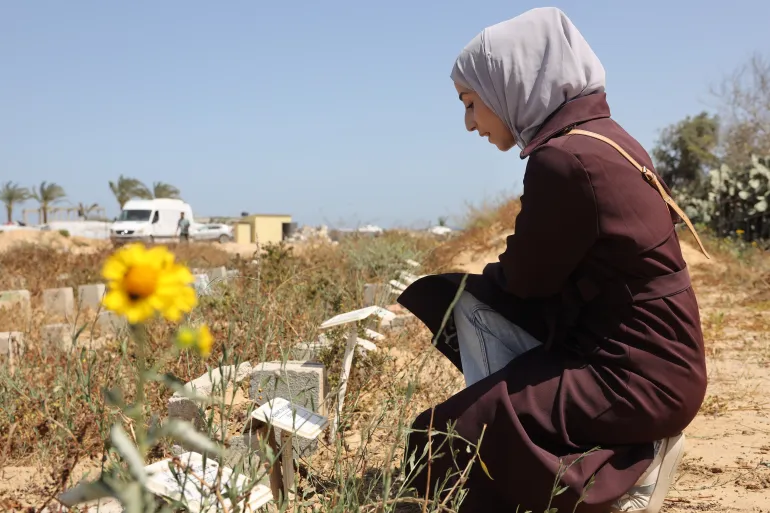

In the city of Deir el-Balah in the Gaza Strip, a cemetery filled with numbered graves has become a painful symbol of the humanitarian crisis caused by the ongoing war.
The site, known locally as the “cemetery of the missing”, contains the bodies of hundreds of unidentified Palestinians recovered from destroyed buildings, hospitals and streets across Gaza. Many families believe their loved ones may be buried there, but without official identification, certainty remains impossible.
Among them is 26-year-old Lina al-Assi, who has been searching for her husband, Jihad Tafesh, since October 2023. He disappeared during heavy Israeli bombardment in Gaza City while Lina fled with their two young children.
Despite repeated attempts to obtain information through humanitarian organisations and hospitals, Lina never learned whether her husband was killed, injured or detained. After the ceasefire agreement in 2025, she began visiting hospitals where returned bodies were displayed for identification.
The process proved deeply traumatic. Many bodies were severely damaged or decomposed, making recognition difficult. Lina eventually believed one of the unidentified bodies resembled her husband, but by then it had already been buried in the cemetery under a number instead of a name.
The cemetery was established as emergency burial space after Gaza’s existing cemeteries became inaccessible or overcrowded. According to local officials, around 1,400 graves have been prepared, with hundreds already occupied by unidentified victims.
Forensic teams photograph bodies, collect samples and document personal belongings before burial. However, the absence of functioning DNA laboratories in Gaza has made proper identification almost impossible.
Humanitarian workers warn that families of the missing continue to suffer severe emotional distress as they remain trapped between hope and mourning. International organisations have called for better forensic support and the transfer of DNA samples abroad to help identify victims.
For Lina and many others, the cemetery is more than a burial ground - it is the only place where they feel close to those they lost.
“All I want is for my husband to have a grave with his name,” Lina says. “So our children can visit him and know where he rests.”




.jpg)
.jpg)

.jpg)