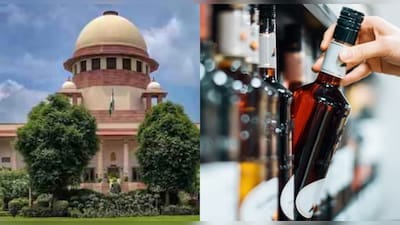


New Delhi: The Supreme Court has made significant observations on the effectiveness and practical consequences of alcohol prohibition. A bench comprising Justice J.B. Pardiwala and Justice K. Vinod Chandran referred to five major concerns associated with prohibition policies: loss of government revenue, the financial burden of enforcing prohibition, the possibility of corruption in the police and administrative system, the growth of illegal liquor markets and the risk of people shifting towards other intoxicating substances.
The observations were made while the court was dealing with a challenge to Rules 18A and 18B of the Maharashtra Poisons Rules, 1972. The Supreme Court struck down these provisions, which regulated the purchase and possession of methanol. The rules required methanol sold to non-drug manufacturers to be mixed with specified bittering and colouring substances before sale. Rule 18B also provided for confiscation of methanol in certain circumstances where the required licence was not available.
The court discussed the broader question of prohibition while examining whether the Maharashtra rules were actually connected to the objective of preventing deaths caused by spurious liquor.
The first concern mentioned by the court was loss of revenue. Alcohol sales generate substantial excise revenue for state governments. A complete ban therefore has a direct impact on this source of government income. At the same time, prohibition is generally introduced with the objective of reducing alcohol consumption and its social and health-related consequences.
The second concern relates to the cost of enforcement. A prohibition policy requires continuous monitoring by police, excise authorities and the administration. Preventing illegal manufacturing, transportation, storage and sale of liquor requires investigations, raids, surveillance and prosecution, all of which involve public resources.
The third concern is the possibility of corruption. When a product is completely prohibited, an illegal market can develop around it. This increases the importance of enforcement agencies and can create opportunities for bribery and other forms of corruption, the court observed in the context of the broader prohibition debate.
The fourth concern is the growth of illegal and potentially dangerous liquor. The court referred to the historical experience of prohibition and observed that a complete ban can sometimes push liquor trade underground. Illegal liquor markets may operate outside normal quality and safety controls, increasing the danger of toxic or adulterated liquor.
The fifth concern is the possible increase in the use of other intoxicating substances. The court also referred to the risk that restrictions on alcohol could lead some people towards other forms of drugs and intoxicants.
The Supreme Court also referred to Gujarat, where a strict prohibition policy has been in place for decades. According to the observations recorded by the court, Gujarat has witnessed at least 10 major hooch tragedies since the state's formation, resulting in more than 600 deaths. The court cited this experience while discussing the limitations of relying only on prohibition to eliminate illegal liquor markets.
The background of the Maharashtra case goes back to a major hooch tragedy in Mumbai in 1991, in which around 93 people died after consuming spurious liquor containing methanol. Following the tragedy, steps were taken to strengthen regulation concerning methanol and its possible diversion for the manufacture of illicit liquor.
The Maharashtra Poisons Rules, 1972 were subsequently amended in 2011. Rules 18A and 18B were introduced as part of this regulatory framework. Rule 18A required sellers to verify the intended use of methanol and imposed a requirement to add specified substances before selling methanol for non-drug manufacturing purposes. Rule 18B dealt with confiscation of methanol found without the required licence.
The Supreme Court examined whether these restrictions were proportionate to the objective of preventing deaths from methanol-adulterated liquor. The court accepted that preventing deaths from toxic liquor is a legitimate and important objective. However, it held that the government also needed to demonstrate a rational connection between the particular restrictions and that objective.
According to the judgment, the state failed to establish that mandatory addition of colouring and bittering substances to methanol would effectively prevent the manufacture of spurious liquor. The court also considered the possibility that illegal operators could obtain methanol through other channels or use other substances.
The court further observed that existing safeguards relating to the sale, storage and movement of methanol could be implemented more effectively to address diversion and illegal use.
The court also considered the concerns raised by chemical manufacturers regarding the effect of mandatory additives on industrial processes and the quality and usability of methanol-based products.
Importantly, the Supreme Court clarified that it had no reason to doubt the intention of the state government. However, good intentions alone cannot save a regulation if the regulation itself fails the test of legality and proportionality.
The ruling is primarily concerned with the validity of Rules 18A and 18B of the Maharashtra Poisons Rules. However, the observations made during the judgment have broader significance for the continuing debate around alcohol prohibition, illegal liquor markets, methanol regulation and the prevention of hooch tragedies.



.jpg)
.jpg)