
The political debate over the Election Commission's Special Intensive Revision, or SIR, of electoral rolls has intensified following a report about objections allegedly raised by two Election Commissioners.
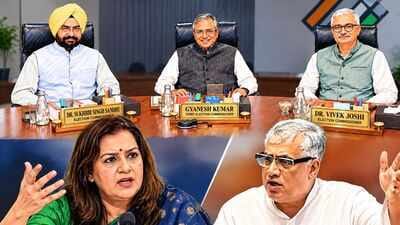
According to the report, Election Commissioners Sukhbir Singh Sandhu and Vivek Joshi recorded at least 14 formal objections over a period of 10 months. Four of these objections were reportedly recorded on a single day. The reported concerns involved electoral-roll procedures, voter registration, deletion and restoration of names, changes to Form 6 and the management of voter data and election technology.
The report also said that the two commissioners questioned certain decisions and orders issued in the name of the Election Commission, saying they did not have the necessary information or approval in some cases. These reported objections have now become part of a wider political debate over the functioning of the poll panel.
Opposition parties have used the report to renew demands for action against Chief Election Commissioner Gyanesh Kumar. TMC Rajya Sabha MP Derek O'Brien has asked the Rajya Sabha to bring forward an earlier motion signed by more than 60 opposition MPs seeking Kumar's removal.
O'Brien said that opposition MPs had earlier written to the Rajya Sabha Chairman with a motion seeking the removal of the CEC and argued that the reported objections by two Election Commissioners made it necessary to bring the matter before the House. His statements represent a political demand and are not an independent finding about the functioning of the Election Commission. ([The New Indian Express][2])
What is the SIR controversy?
The Special Intensive Revision is an electoral-roll revision exercise involving the review and updating of voter records. The present controversy concerns the procedures used for adding, deleting and restoring names and the manner in which decisions relating to electoral data were handled.
The reported objections covered several areas. These included changes to Form 6, the system used for adding new voters, the management of voter databases and the handling of appeals related to electoral-roll decisions.
Form 6 is used by citizens seeking inclusion in the electoral roll. The report said that a new question related to the SIR records of an applicant's parents was introduced and that the two commissioners questioned the procedure through which the change was made. Concerns were also reportedly raised about the management and centralisation of electoral data and technology. ([Outlook India][4])
What has the Election Commission said?
The Election Commission has rejected the suggestion that its final decisions reflected an internal split. According to Commission sources, all decisions, including those concerning SIR, were approved by Chief Election Commissioner Gyanesh Kumar and Election Commissioners Sukhbir Singh Sandhu and Vivek Joshi. The Commission has described the final decisions as unanimous.
The Commission's position also distinguishes between internal discussion and final decision-making. In other words, a commissioner raising a question or concern during an internal process does not necessarily mean that the final decision was taken without the approval of the full Commission.
Opposition response
Opposition leaders have argued that the reported objections require greater public clarification about the decisions concerned and the procedures followed. Some opposition MPs have also renewed demands for the removal of the Chief Election Commissioner.
Derek O'Brien has specifically asked that the earlier Rajya Sabha motion signed by more than 60 opposition MPs be brought before the House. Other opposition leaders have also criticised the functioning of the Commission following the report.
At the same time, the Election Commission has not accepted the interpretation that the reported objections show that its final decisions were taken without consensus. It has maintained that all final decisions, including those related to SIR, had the approval of all three commissioners.
Why does the issue matter?
Electoral-roll revision directly affects voter registration and the status of names in electoral rolls. As a result, questions about the procedures used to add, remove or restore names have wider administrative and political significance.
The current dispute therefore has two clearly different aspects: the reported formal objections by two Election Commissioners and the Election Commission's clarification that its final decisions were unanimous. Opposition parties are using the reported objections to demand further action, while the Commission says there was no contradiction in its decision-making process.
Further clarity is likely to depend on the relevant official records, details of the objections and any parliamentary proceedings concerning the motion against the CEC.
Meta Headline:
SIR Row: 14 Objections Reported, EC Says Decisions Were Unanimous


.jpg)
.jpg)