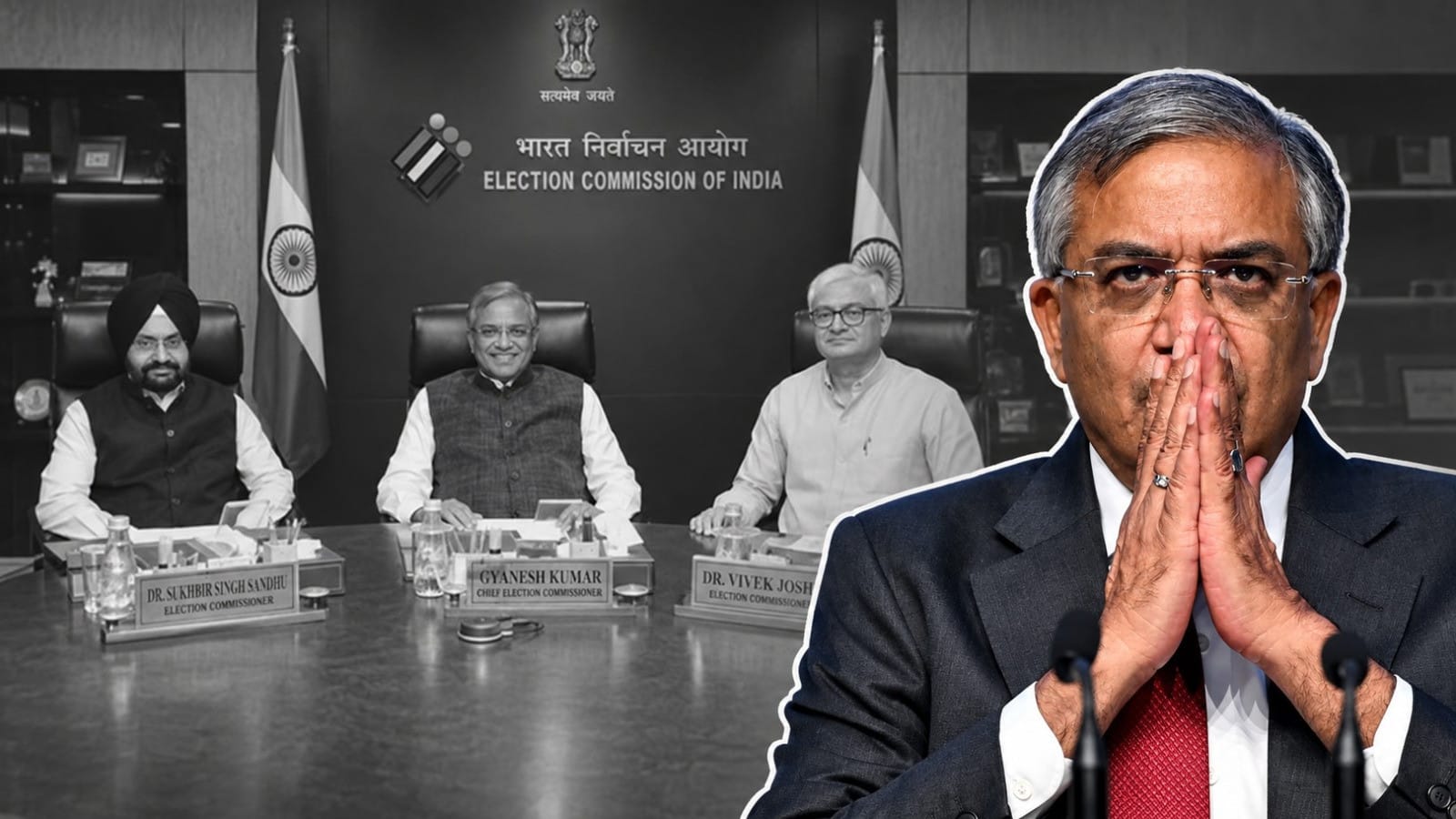

The political controversy surrounding the Special Intensive Revision, or SIR, of electoral rolls intensified on Friday, with opposition parties stepping up their protests against the Election Commission and Chief Election Commissioner Gyanesh Kumar.
The controversy followed a report claiming that Election Commissioners Sukhbir Singh Sandhu and Vivek Joshi had formally raised objections at least 14 times over a period of 10 months regarding decisions and orders issued in the name of the Election Commission. According to the report, the issues included voter additions and deletions, appeals related to electoral rolls and the handling of election-related data and technology.
The report triggered a political reaction from opposition parties, particularly the Congress. The party has directed its state units to organise protest marches to State Election Commission offices on September 25. Congress has demanded the removal of Chief Election Commissioner Gyanesh Kumar and an independent review of decisions and electoral-roll changes made during his tenure. ([The New Indian Express][3])
Security arrangements have also been strengthened around the Election Commission office in New Delhi in view of the planned protest. The Indian Youth Congress has separately announced a march in the capital. Congress has also announced another phase of protests at the district level on September 28.
The report at the centre of the controversy stated that the two Election Commissioners had raised objections on several issues during the 10-month period. The reported concerns included matters related to the addition of new voters, deletion and restoration of names from electoral rolls, appeals against voter-related decisions and access to systems used to manage voter data. The report also stated that four objections were raised on a single day.
However, the Election Commission has rejected the interpretation that the reported objections amounted to a final disagreement within the poll panel. Election Commission officials said that all decisions, including those connected with SIR, were approved by all three Election Commissioners and were ultimately taken unanimously. The Commission also indicated that concerns may have been raised during internal deliberations without necessarily changing the final decision of the panel.
The controversy has also led to demands for an independent examination of the SIR process. Abhijit Deepke, convenor of Cockroach Janta Party, has demanded an independent investigation into SIR, restoration of the earlier electoral roll and changes to the process for appointing the Chief Election Commissioner and other Election Commissioners.
Deepke has also announced further protests if his demand for the CEC's resignation is not accepted. He has said that his organisation could organise another protest at Jantar Mantar and has referred to a nationwide movement from October 2. These are demands and statements made by Deepke and his organisation.
Union Minister Chirag Paswan, while commenting on the controversy, said that the Election Commission is an autonomous institution and that if questions have been raised about its functioning, the Commission, particularly the Chief Election Commissioner, should present its position. He also said that the Commission should focus on maintaining public confidence rather than responding to political criticism.
Chhattisgarh Congress president Deepak Baij has also demanded an independent inquiry into the functioning of the Election Commission in connection with SIR. He alleged that a large number of voters had been removed from electoral rolls during the process. These are allegations made by a Congress leader and should be distinguished from independently established findings.
The SIR controversy has also drawn attention to the handling of appeals in West Bengal. Recent figures indicate that a significant number of appeals arising from the electoral-roll revision process remain pending. According to a recent report based on Election Commission data, around 1.02 lakh of the 38.20 lakh appeals had been disposed of at the time of the report.
The process has also faced judicial scrutiny. The Supreme Court has asked the Election Commission to explain the basis for issuing notices classified as involving “logical discrepancies” during the Delhi SIR process. The court has sought clarification regarding the criteria used for such notices. The Election Commission has stated that no voter would be removed from the electoral roll without due process and an opportunity for hearing.
Congress general secretary Jairam Ramesh has also entered the political debate by referring to the constitutional amendment that reduced the minimum voting age from 21 to 18. He contrasted former Prime Minister Rajiv Gandhi with Prime Minister Narendra Modi in a political statement concerning voting rights and the current SIR controversy.
The 61st Constitutional Amendment Act, 1988, changed the minimum voting age under Article 326 from 21 years to 18 years.
At present, the SIR controversy involves competing claims and responses. Opposition parties are raising questions about the electoral-roll revision process, changes to voter lists and reported internal objections, while the Election Commission maintains that the final decisions were taken unanimously. The issue is therefore being debated simultaneously at the political, administrative and judicial levels.

.jpg)
.jpg)