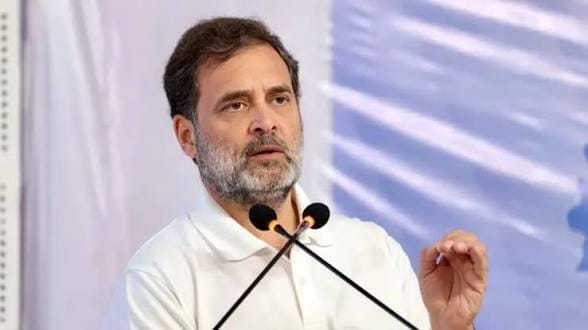

Congress leader Rahul Gandhi has targeted the Aam Aadmi Party (AAP) government in Punjab over the murder of Parvinder Singh Jhota and the wider issue of drug-related activities in the state. In a social media post, Gandhi raised questions about the safety of people who speak out against drugs and called on Chief Minister Bhagwant Mann to explain what steps were being taken to protect them.
The Congress leader alleged that raising one’s voice against drugs had become dangerous in Punjab under the AAP government. He referred to incidents involving Parvinder Singh Jhota in Mansa, Gulzar Singh in Sangrur and Mohanjeet Singh, whose case he said involved allegations of custodial torture and was before the High Court. Gandhi used these examples to question the government’s handling of complaints related to drugs and the treatment of people who raise such concerns.
The allegations mentioned in the post are part of Gandhi’s political criticism of the state government. The circumstances of the individual cases, including the claims made by families and allegations relating to police action, must be assessed on the basis of official records, investigation findings and judicial proceedings.
Rahul Gandhi Raises Questions Over Parvinder Singh Jhota’s Murder
In his post, Gandhi referred to the murder of Parvinder Singh Jhota in Mansa. He described Jhota as someone who had been associated with the campaign ‘Stop Drugs, Provide Jobs’. According to Gandhi, Jhota was shot in broad daylight, and footage of the incident was visible during a Facebook Live broadcast.
Gandhi linked the incident to concerns about the safety of people who campaign against drug-related activities. He questioned the Punjab government over what protection is available to individuals who speak publicly about the drug problem and demand action from the authorities.
The remarks came amid reports of a Punjab shutdown called in protest against Jhota’s murder. The incident has brought renewed attention to the issue of drug-related activities, the safety of local campaigners and the role of law enforcement agencies in responding to complaints.
Gandhi’s comments have added a political dimension to the case, with the Congress questioning the AAP government’s accountability. However, the circumstances surrounding the killing and any alleged connection between the incident and Jhota’s anti-drug activities need to be established through the investigation and other verified information.
Gulzar Singh’s Case in Sangrur Also Mentioned
Gandhi also referred to a case involving Gulzar Singh in Sangrur district. According to the account shared in his post, Singh had raised concerns about drugs in his village in front of a minister. Gandhi said Singh’s family alleged that he was subsequently pressured to apologise and later died by suicide.
The Congress leader cited the case while raising broader questions about whether people who report drug-related concerns receive adequate protection and support. He argued that individuals who bring such problems to the attention of public representatives should be able to do so without fear of intimidation or retaliation.
The claims concerning pressure on Gulzar Singh were attributed to his family in Gandhi’s post. The full circumstances surrounding his death and the allegations of pressure require careful verification through official records and any available investigation findings. The cause of a death and the role of alleged pressure should not be treated as conclusively established without supporting evidence.
Allegations of Custodial Torture in the Mohanjeet Singh Case
Gandhi also mentioned Mohanjeet Singh, alleging that he faced torture while in custody after speaking out against drugs. According to Gandhi’s post, the matter is now before the High Court.
The Congress leader cited the case to raise questions about how complaints from people who oppose drug-related activities are handled. He argued that the authorities must take such complaints seriously and ensure that people who report wrongdoing are protected.
Allegations of custodial torture are serious and require careful examination. The claims, the responses of the authorities and the status of the legal proceedings should be assessed through court records and other reliable documentation. Gandhi’s comments represent his account of the matter and should not be presented as a final judicial finding.
‘The Complainant Becomes an Accused’: Gandhi’s Allegation
A key part of Gandhi’s criticism concerned the police action reportedly taken after Jhota made a complaint. Gandhi alleged that an FIR was registered following the complaint and that Jhota was subsequently booked by the police as well.
He questioned how people could be expected to speak openly against drug-related activities if a person making a complaint could also face legal action. Gandhi argued that such circumstances could undermine public confidence and discourage people from reporting suspected wrongdoing.
The Congress leader used the phrase that the person making a complaint ends up becoming an accused to highlight what he described as a failure to protect people speaking out against drugs. However, the exact circumstances of the FIR, the allegations recorded in it and the legal status of the proceedings need to be verified from official records. The registration of a case does not, by itself, establish guilt.
The central issue raised by Gandhi is whether people who report suspected drug-related activities receive adequate protection and whether complaints are investigated fairly. The police and state government’s account of the cases will be important in assessing the allegations.
Rahul Gandhi Seeks Answers From Chief Minister Bhagwant Mann
Gandhi directly questioned Chief Minister Bhagwant Mann over the safety of people who campaign against drugs in Punjab. He asked who would protect individuals who raise concerns about the drug problem and demand action from the authorities.
He also alleged that drug-related activities were damaging the future of Punjab’s youth and called for effective action to address the problem. Gandhi said the Congress would continue to raise the issue until steps were taken to tackle the drug trade and protect young people.
The remarks indicate that the Congress intends to use the issue to question the AAP government’s record on drug control and public safety. By referring to several separate cases, Gandhi sought to argue that the protection of anti-drug campaigners should be treated as a matter of public concern.
The state government’s response, the progress of investigations and the findings of the courts will be significant in determining the facts surrounding the cases mentioned in the post.
Drug Problem Returns to the Centre of Punjab’s Political Debate
The drug problem in Punjab has long been a subject of public concern and political debate. Parties have repeatedly called for stronger action against drug trafficking, greater protection for young people and effective measures to prevent the spread of drug-related harm.
The murder of Parvinder Singh Jhota and Gandhi’s subsequent remarks have brought the issue back into the political spotlight. The Congress has questioned the AAP government’s accountability and demanded answers from the chief minister.
The cases mentioned by Gandhi involve separate circumstances and should be examined individually. Their factual and legal details, including the status of investigations and court proceedings, will be important in evaluating the claims. For now, Gandhi’s post has intensified the political dispute over drug control, public safety and the protection of people who raise concerns about suspected wrongdoing in Punjab.

.jpg)
.jpg)