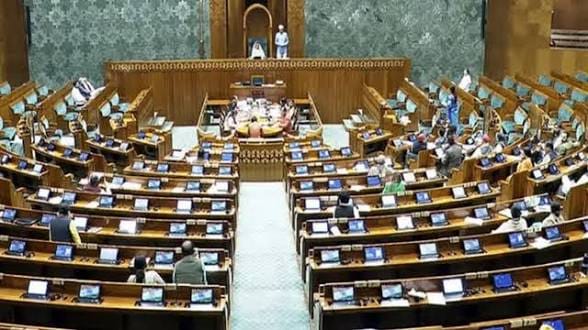

New Delhi: The central government may consider convening a special session of Parliament towards the end of the month to bring legislation related to women's reservation and delimitation back before lawmakers. According to the information available, the proposed session could be aimed at securing parliamentary approval for the bills. However, an official announcement confirming the session, its date and its agenda would be necessary before the proposal can be treated as final.
The possibility of a special session comes amid continuing political opposition over Chief Election Commissioner Gyanesh Kumar and the Special Intensive Revision (SIR) of electoral rolls. At the same time, women's reservation and delimitation have emerged as significant issues in the parliamentary debate. The government's reported plan is being viewed as an attempt to revisit the legislation and build the support required for its passage.
Why Did the Earlier Bill Fail to Pass?
During the Budget Session, a constitutional amendment bill intended to implement women's reservation in the Lok Sabha and state legislative assemblies failed to secure passage in the Lok Sabha on April 17, according to the information provided. The proposal also included provisions related to delimitation. Its failure to pass left questions about the implementation of women's reservation and the proposed restructuring of electoral constituencies at the centre of political discussion.
Women's reservation is intended to increase the representation of women in elected legislative bodies. Delimitation, meanwhile, involves redrawing constituency boundaries and determining representation. Both issues have significant constitutional and political implications, making parliamentary support essential for any proposed constitutional changes.
What Is the Required Number to Pass the Bill?
A constitutional amendment bill requires more than an ordinary majority. Under Article 368 of the Constitution, such a bill must be passed separately in each House of Parliament by a special majority. This generally requires a majority of the total membership of that House, along with the support of at least two-thirds of the members present and voting.
As a result, the government needs to secure the prescribed special majority in both the Lok Sabha and the Rajya Sabha. The political calculation is therefore more complicated than simply relying on the ruling alliance's existing majority. The figure of around 360 Lok Sabha members has been cited in the available account as an important benchmark. However, the precise requirement depends on the House's effective membership and the number of members present and voting.
Government Hopes to Improve Its Numbers
The National Democratic Alliance (NDA) has a majority in the current Lok Sabha, but the information provided suggests that obtaining the special majority needed for a constitutional amendment remains a challenge. The government is reportedly hopeful that the political arithmetic could be more favourable than it was during the previous session.
The account claims that 20 Trinamool Congress MPs and six Shiv Sena (Uddhav Balasaheb Thackeray) MPs have joined the ruling side. This claim requires independent confirmation and should not be treated as an established parliamentary development without verification. Any confirmed change in parliamentary support could affect the government's calculations, but the final numbers would need to be assessed against the actual voting position in both Houses.
*Support From Other Parties Could Be Crucial*
The government is also reportedly hoping to obtain support from other parties, including the Sharad Pawar faction of the Nationalist Congress Party. The available account refers to eight MPs associated with that faction. The possibility of support is linked to a reported assurance that a guaranteed 50 per cent increase in seats would be included in the bill.
According to the account, Supriya Sule had earlier indicated that her party would be willing to hold discussions if a 50 per cent increase in seats were guaranteed. Such a statement would indicate a possible opening for negotiations, rather than final agreement to support the legislation. The party's formal position and the final wording of the proposed bill would be important in determining whether an understanding can be reached.
What Happens Next on Women's Reservation and Delimitation?
If the government convenes a special session, Parliament could take up the women's reservation and delimitation proposals again. The government would need to explain the provisions, address concerns over the proposed increase in seats and secure the required constitutional majority. Discussions with alliance partners and other political parties could play an important role in this process.
For now, the possibility of a special session and the government's efforts to secure support remain matters to watch. The central challenge will not simply be introducing the bills, but ensuring that they receive the necessary special majority in both the Lok Sabha and the Rajya Sabha. The final position will become clearer once the government announces its plans, the proposed legislative agenda is confirmed and the parties concerned clarify their positions.


.jpg)
.jpg)